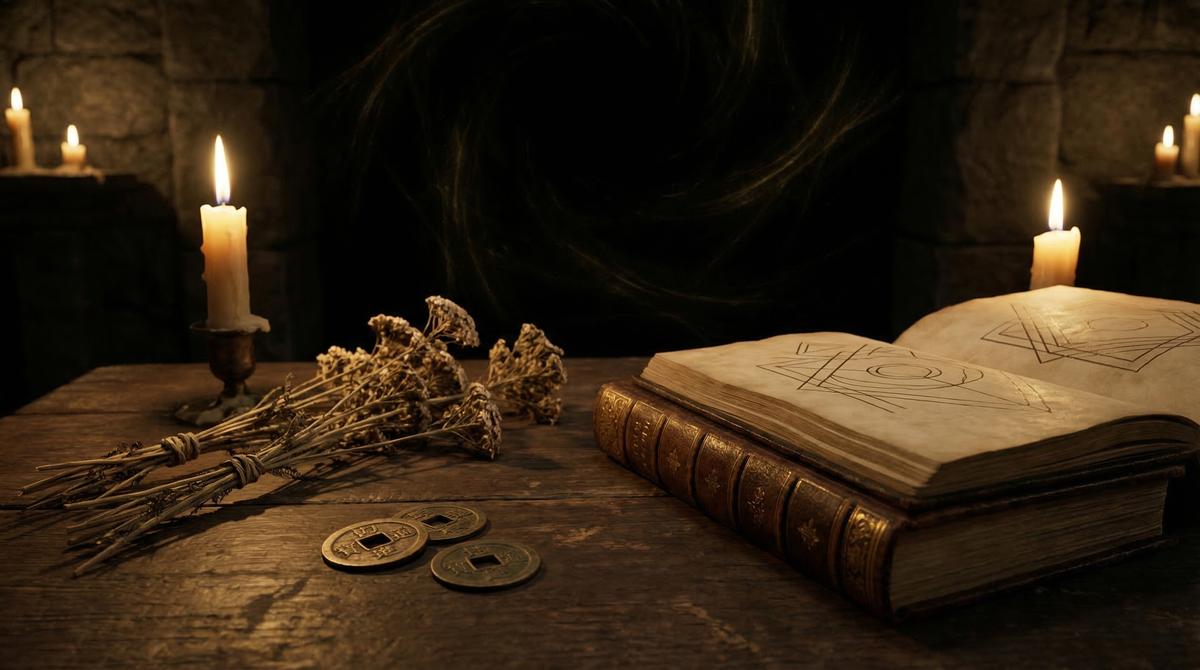
The Zhou Yi, also known as the I Ching (Book of Changes), is an ancient classic often shrouded in mystery. Many are curious about it yet feel intimidated by its vastness. Is it an esoteric philosophy or a practical divination tool? The answer is: both. It is the wellspring of Chinese wisdom and a unique decision-support system.
If you are standing outside the door of I Ching studies, feeling lost and unsure where to begin, this article was written for you. We will cut through the fog and guide you step by step, in the simplest possible way, from zero to mastering the core methods of I Ching divination.
1. Core Concepts: Yin-Yang and the Eight Trigrams
To understand the I Ching, you must first grasp its most basic elements: Yin (⚋) and Yang (⚊). The ancients believed that everything in the universe is composed of these two opposing yet unified energies. Yang represents the positive, bright, ascending, and masculine; Yin represents the receptive, dark, descending, and feminine. They are not a division of good and evil, but symbols describing different states of things.
By combining Yin and Yang lines in groups of three, eight basic figures are formed -- these are the "Eight Trigrams" (Ba Gua). They are the cornerstone of the I Ching system, each symbolizing one of the eight fundamental phenomena in nature.
The Eight Trigrams
| Name | Symbol | Nature | Core Imagery |
|---|---|---|---|
| Qian | ☰ | Heaven | Creation, strength, father |
| Kun | ☷ | Earth | Receptivity, nurturing, mother |
| Zhen | ☳ | Thunder | Action, arousing, eldest son |
| Xun | ☴ | Wind | Penetration, gentle, eldest daughter |
| Kan | ☵ | Water | Danger, abyss, middle son |
| Li | ☲ | Fire | Clinging, radiance, middle daughter |
| Gen | ☶ | Mountain | Stillness, keeping still, youngest son |
| Dui | ☱ | Lake | Joy, openness, youngest daughter |
Memorizing these eight basic symbols and their associations is the first step in learning to interpret hexagrams.
2. From Eight Trigrams to Sixty-Four Hexagrams
The wisdom of the I Ching goes beyond the eight trigrams. When we stack any two trigrams on top of each other, we form the more complex sixty-four hexagrams. Each hexagram consists of six lines and describes one of sixty-four fundamental life situations or developmental stages -- from success to adversity, from union to separation. Through divination, we obtain one of these sixty-four hexagrams as a mirror reflecting the current state and future trajectory of our question.
3. Casting a Hexagram: The Ritual of Cosmic Communication
"Casting" or "consulting the oracle" involves using a random ritual to obtain the hexagram corresponding to your current question. For beginners, we recommend the simplest and most commonly used "Three Coin Method."
Three Coin Method Steps:
- Preparation: Find three identical coins and prepare paper and pen.
- Calm Your Mind: Find a quiet space, close your eyes, take several deep breaths, and clear your thoughts.
- Ask Your Question: Clearly and specifically state (silently or aloud) the question you want answered. The more specific your question, the more targeted the insight.
- Toss the Coins: Hold the three coins in your palm, shake them, and gently toss them. Repeat this process six times, each result corresponding to one line of the hexagram. Record from bottom to top.
- Record Each Line: Assign heads as Yin (value 2) and tails as Yang (value 3). Calculate the total for each toss:
- 7 (two heads, one tail): Young Yang -- a stable Yang line ⚊
- 8 (two tails, one head): Young Yin -- a stable Yin line ⚋
- 9 (three tails): Old Yang -- a changing Yang line
- 6 (three heads): Old Yin -- a changing Yin line
- Form the Hexagram: After six tosses, you have the "Primary Hexagram." If any lines are "Old Yang" or "Old Yin" (changing lines), flip them to their opposite to form the "Transformed Hexagram."
Key Insight: The casting process is fundamentally about sincerity. "Sincerity brings efficacy" is not superstition -- it refers to a focused, engaged state that allows you to better connect with your subconscious and the universe's energy field.
4. Interpreting the Hexagram: Decoding the I Ching's Wisdom
With your hexagram in hand, the most crucial step is interpretation. A complete reading includes three parts: the Primary Hexagram, the Changing Lines, and the Transformed Hexagram.
Basic Interpretation Approach:
- Read the Primary Hexagram Text: The primary hexagram represents the overall current situation and basic trend of your question.
- Focus on Changing Line Texts: Changing line texts provide the most specific, direct advice for your personal situation. With one changing line, use that line's text as your primary reference; with multiple, synthesize them.
- Consider the Transformed Hexagram: The transformed hexagram reveals the future direction or potential outcome of the situation.
Interpretation is not rigid translation -- it requires combining the text with your own circumstances, exercising intuition and association. The hexagram provides symbolic guidance, not absolute commands.
5. Learning Resources and Advanced Suggestions
- Classic Reading: Richard Wilhelm's translation, The I Ching or Book of Changes, is the most authoritative Western version with deep and inspiring commentary. For Chinese readers, Nan Huai-jin's Miscellaneous Talks on the I Ching provides an accessible and engaging entry point.
- Practice Regularly: Cast hexagrams for yourself or friends, and keep a "divination journal." Record each question, hexagram, interpretation, and how things actually developed -- reviewing these will deepen your understanding.
- Maintain Reverence and Openness: Do not treat the I Ching as absolute fortune-telling truth. It is more like a wise elder offering you a different perspective. The final decision always remains in your own hands.
Learning the I Ching is a journey of exploring yourself and the universe. What it teaches us is not merely the technique of predicting the future, but a life philosophy of following nature, remaining calm amid change, and maintaining balance. May this beginner's guide light the first lamp on your path forward.