Office Desk Feng Shui Guide: 10 Tips to Boost Your Career Fortune
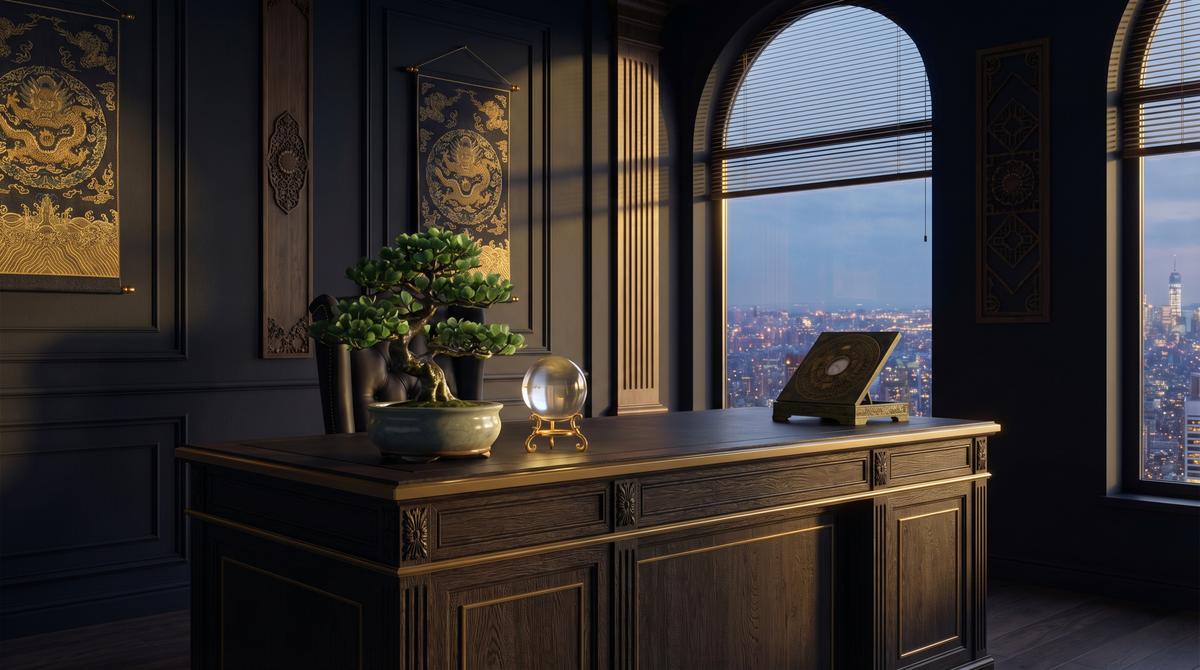
I've had an unusual number of clients asking me the same question lately: "How should I set up my desk for better feng shui?" And honestly, it makes perfect sense. You spend eight hours a day -- sometimes more -- sitting at your desk. The energy of that one spot directly shapes your career trajectory, your relationships with colleagues, and even your financial luck.
Over the years, I've consulted on hundreds of office layouts. I've seen managers get promoted within months of repositioning their desk, and I've watched talented people stagnate because their workspace was working against them energetically. Today I'm sharing the ten most practical feng shui tips for your office desk -- whether you work in a corporate tower, a home office, or a coworking space.
1. The Command Position: Where Your Desk Should Face
In feng shui, the command position is the most powerful spot in any room. The principle is straightforward: face the door, back against a solid wall.
Why face the door? The door is where qi (energy) enters the room. It's where opportunities, people, and information flow in. When you face the door, you can see who's coming -- literally and metaphorically. Psychologically, it puts you in a position of authority. You feel more confident making decisions, and people instinctively perceive you as someone in charge.
Having a solid wall behind you represents "backing" or support -- a stable foundation for your career. Think of it like a general commanding an army: you want a mountain at your back, not empty air.
One of my clients, a department manager at a tech firm, had been struggling with team dynamics for over a year. His desk faced the wall with his back to the door. Every time someone walked in, he'd startle. I suggested he rotate his desk 180 degrees -- facing the door, back to the solid wall. Within three months, he reported noticeably smoother team communication. He ended that quarter as the top-performing department in the company.
Positions to absolutely avoid: Back to the door (creates subconscious anxiety -- you'll always feel like someone's watching you), facing a bathroom door (sha qi, or negative energy, flows directly at you), or directly aligned with an elevator (unstable, fluctuating energy).
2. Desk Facing a Window: Good or Bad?
This is one of the most common feng shui desk questions I get. Many people love the idea of a window seat -- great natural light, a nice view. But from a feng shui perspective, you need to understand the difference between sitting with a window behind you versus facing a window.
Window behind you (back to window): This is problematic. A window is "empty" -- it doesn't provide the solid support that a wall does. In feng shui terms, you have no backing. You might notice that your opinions carry less weight in meetings, or that colleagues don't take your ideas as seriously. The energy behind you literally has nowhere to rest.
Facing a window directly: Better than back-to-window, but still not ideal. The light is nice, but qi scatters outward through the glass. You'll find your concentration drifting, your mind wandering. This is especially true on higher floors, where the vast openness outside creates a sense of groundlessness.
The best arrangement is having the window to your left side. In feng shui, the left side of your desk is the Green Dragon position (more on that in Tip 4) -- it's the side associated with positive energy, growth, and benefactors. Natural light flowing in from the left energizes this auspicious side without destabilizing your qi.
If you're stuck facing a window and can't move your desk, here are some remedies:
- Install blinds or sheer curtains -- control the light and slow down the outward flow of qi.
- Place a row of small plants on the windowsill -- they act as a living barrier, filtering and softening the energy.
- Put a natural crystal on your desk -- clear quartz or amethyst can anchor your personal energy field.
3. Desk Facing a Wall: How to Fix It
Welcome to the reality of cubicle life. Millions of office workers sit down every morning and stare straight at a blank wall or partition, six inches from their face. In feng shui, this is called "facing-wall sha" -- it symbolizes blocked opportunities, limited vision, and career stagnation.
The good news? This is one of the easiest feng shui problems to fix:
- Hang an expansive landscape image -- A photograph or painting of mountains and open water works best. It creates a visual sense of depth and symbolizes a bright, open future. Avoid images of waterfalls flowing downward (suggests wealth draining away).
- Place a small round mirror -- A small, circular mirror visually expands the space and symbolically "opens your path forward." Keep it small and round -- a large rectangular mirror creates too much reflective sha qi.
- Put a crystal ball on your desk -- A clear quartz sphere purifies the energy field and counteracts the oppressive feeling of a close wall.
- Use an inspiring poster or world map -- A city skyline, world map, or expansive horizon image visually breaks the wall and sets your mind on bigger possibilities.
4. The Green Dragon and White Tiger Principle
This is one of the foundational concepts in desk feng shui, and once you understand it, you'll never arrange your desk the same way again. When you sit at your desk: your left side is the Green Dragon (Qing Long) position, and your right side is the White Tiger (Bai Hu) position.
The rule is simple: the Green Dragon side should be higher and more active than the White Tiger side. The Dragon represents benefactors, growth, and positive opportunities. The Tiger represents challenges, conflict, and competition. You want the Dragon to dominate.
Here's how to apply it:
- Left side: stack it higher -- Put your file organizer, book stand, or monitor riser on the left. Height on the Dragon side activates benefactor luck.
- Phone on the left -- Your phone represents communication and connections. Placing it on the Dragon side means "benefactors calling in." If you're in sales or any relationship-driven role, this small change can shift the quality of your incoming calls.
- Right side: keep it lower and calmer -- Don't pile things high on the Tiger side. Clutter or tall objects here stir up office politics and arguments.
- If you must keep things on the right -- opt for soft items: a tissue box, a coaster, a small cushion. Avoid sharp metal objects on the Tiger side.
I had a client in sales who kept her phone on her right side. She was constantly fielding complaints and difficult customers. After moving her phone to the left and clearing the right side, she noticed a gradual but real shift -- more referrals, more warm leads, fewer confrontational calls. Coincidence? Maybe. But when the cost of trying is zero, why not?
5. Computer and Monitor Placement
Since nearly everyone works on a computer now, its placement matters from a feng shui perspective:
- Don't position your screen directly facing the door -- Qi rushing in from the door hits your screen and scatters your focus. Plus, anyone walking by gets a full view of your work -- bad for privacy and concentration.
- Place your computer in the wealth corner -- Standing at the door and looking into the room, the diagonal far corner is typically the wealth position. Putting your computer (your modern money-making tool) here symbolically activates financial energy.
- Multi-monitor users, watch the enclosure effect -- If your screens wrap around you in a U-shape, it creates a sense of being boxed in. This constricts your thinking and makes you feel pressured. Keep monitors side by side in front of you with breathing room on both sides.
- Laptop warriors -- If you work from different spots (coffee shops, coworking spaces), take five seconds at each new location to identify where the door is. Face it, or at least sit at an angle where you can see it. Never put your back to the entrance.
6. What to Put on Your Desk: Career-Boosting Items
Your desk surface is prime feng shui real estate. Here's what earns a spot:
- A small living plant -- Represents growth, vitality, and fresh energy. Pothos, lucky bamboo, or a small jade plant are all excellent choices. Place it in the front-left area of your desk (Green Dragon zone). The key word is "living" -- the plant needs to be healthy and thriving.
- Clear quartz crystal -- Purifies the energy around your workspace and enhances mental clarity. Place it near your computer to counterbalance electronic energy. Even if you're skeptical about crystals, the visual reminder to stay clear-headed has its own psychological benefit.
- A Wen Chang pagoda (文昌塔) -- If your work involves writing, analysis, research, or any form of intellectual output, this is your best friend. It activates scholarly and creative energy. Place it in the front-left area of your desk.
- A small water feature or fish bowl -- Water represents wealth in feng shui. A miniature fountain or a small bowl with a single goldfish activates financial qi. The water must be moving (stagnant water = stagnant money). Recommended fish counts: 1, 6, 8, or 9.
- A meaningful photo -- A family photo or an image that motivates you. Place it on the right side (White Tiger position) -- it softens the Tiger energy with warmth and emotional purpose.
7. What NOT to Put on Your Desk: Feng Shui Don'ts
Some objects seem harmless but create subtle energetic problems:
- Cactus or thorny plants -- Yes, the internet says they absorb radiation. Feng shui says their thorns generate sha qi (sharp, aggressive energy). They can trigger interpersonal friction, attract petty rivals, and make your work relationships prickly -- literally.
- Piles of messy papers -- Clutter blocks qi flow. You've experienced this yourself: the messier your desk, the harder it is to think clearly. Regular desk decluttering is, in itself, a feng shui practice. Make it a Friday ritual.
- A mirror facing you -- A mirror pointed at you bounces your own energy back, creating a loop of self-focused, anxious energy. If you keep a compact mirror for touch-ups, close it and put it away when you're done.
- Wilting plants or artificial flowers -- Dead or dying plants represent declining energy. Fake flowers look nice but carry no life force. Either commit to keeping a real plant alive, or skip plants entirely.
- A tangle of cables and too many devices -- Phones, tablets, chargers, and cables piled together create electromagnetic clutter, which feng shui calls "electronic sha." It makes you feel frazzled and scattered. Use a cable organizer or desk tray to keep things tidy.
8. Industry-Specific Desk Feng Shui
Different industries align with different elements in the Wu Xing (Five Elements) system. Tailoring your desk setup to your industry's element can give you an extra edge:
| Industry | Element | Best Desk Direction | Recommended Items & Colors |
|---|---|---|---|
| Creative / Design / Media | Wood | Face East | Plants, blue-green accessories, wooden desk surface |
| Finance / Banking / Investment | Metal | Face Northwest | Metal desk accessories, white/silver accents, Chinese coins |
| IT / Technology / Engineering | Water | Face North | Small water feature, blue-black color scheme, curved shapes |
| Sales / Marketing / PR | Fire | Face South | Red accents, triangular decor, a good desk lamp |
| Real Estate / Agriculture / Construction | Earth | Face Southwest or Northeast | Ceramic items, yellow/brown tones, square shapes |
These are general guidelines. For more precision, the ideal approach is to work with your personal BaZi (Four Pillars of Destiny) chart. Your favorable element might differ from your industry's element. For example, if you work in tech (Water) but your BaZi chart says Fire is your favorable element, you'd actually want to incorporate some Fire energy into your setup rather than going all-in on Water.
9. Home Office Feng Shui (Working from Home)
Remote work has exploded since 2020, and many people are now permanently working from home. Some assume feng shui doesn't apply to home offices. It applies even more -- your home's energy is complex, with different rooms carrying different functions, and the lines between "work" and "rest" blur easily.
- Never work in your bedroom -- The bedroom is yin energy (rest, sleep, intimacy). Working there mixes yang (active, productive) energy into a yin space. You'll find yourself sluggish during work hours and restless at bedtime. If you absolutely must work in the bedroom, use a folding screen, bookshelf, or curtain to physically separate the work zone from the sleeping zone.
- A dedicated study or office room is ideal -- A room with a door you can close creates an independent energy field. When you walk in and close the door, you're signaling to your subconscious (and to the qi of the space) that it's time to work.
- Back to a solid wall still applies -- At home or in an office, the command position principle is universal. Don't sit with your back to a window, a hallway, or an open-plan living area.
- Don't face your bed -- If you're in the bedroom and your desk faces the bed, your brain will constantly whisper "just lie down for a minute." Productivity drops, and the boundary between work and rest erodes completely.
- Maximize natural light -- Home environments can be dimmer than offices. A dark workspace makes yin energy dominant, which drags down your drive and motivation. Open curtains during the day. At night, use a warm-white desk lamp -- avoid harsh fluorescent light.
- "Close shop" at the end of the workday -- When you're done working, put your papers away, close your laptop, and physically reset the space. Don't let work energy permeate your home 24/7. This simple ritual preserves the energetic boundary between career and personal life.
10. Special Tips for 2026: The Year of the Fire Horse
2026 is a Bing Wu year (丙午) -- Fire on Fire. The Heavenly Stem is Bing (yang Fire) and the Earthly Branch is Wu (the Horse, also Fire). This makes 2026 an intensely fiery year. In the workplace, expect heightened competition, faster pace, and shorter tempers all around.
Your desk feng shui needs some year-specific adjustments:
- Tone down red and orange -- Adding more Fire to an already Fire-dominant year is like pouring gasoline on a campfire. It leads to impulsive decisions, arguments with colleagues, and burnout. If your BaZi chart already has strong Fire, be extra cautious.
- Add blue and black accents (Water element) -- Water controls Fire. A blue mouse pad, a black pen holder, a navy desk organizer -- small touches that keep the Fire energy in check. You don't need to redecorate; subtle additions work fine.
- Place a healthy green plant in the southeast -- The southeast is the growth sector this year. A thriving plant here channels excess Fire into Wood (Fire produces Earth, but Wood mediates and creates a productive cycle).
- Recommended crystals for 2026 -- Black obsidian (protective + Water energy to counter Fire), blue tiger's eye (emotional stability + sharper judgment), and a brass Wu Lou/gourd (neutralizes the Five Yellow star's negative influence).
- Watch the northwest sector -- Depending on your office layout, if your desk sits in a sector affected by the annual Five Yellow (Wu Huang) star, place a set of six Chinese brass coins or a small metal wind chime nearby to dissolve the sha energy.
The core strategy for a Fire Horse year: Use Water to temper Fire, stillness to balance speed. Keep your workspace calm, cool, and uncluttered. This isn't the year for a loud, flashy desk setup.
Final Thoughts
At its heart, desk feng shui is about optimizing the micro-environment where you spend the most waking hours. Get the direction right, arrange the energy properly, and your work state naturally improves. I've seen people complain about bad luck and career stagnation for years without ever noticing that their desk was in the worst possible position.
Of course, feng shui isn't a magic bullet. It's a supporting tool -- one that helps you get better results from the same effort. What ultimately determines your career success is your skill, attitude, and choices. But if you can align yourself with the natural flow of energy, why wouldn't you?
Start with the easiest changes from this list: declutter your desk, adjust your facing direction, make the left side higher than the right. Small shifts, done consistently, create real momentum over time.
Want to know exactly what should go on your desk based on your personal energy profile? Take our Feng Shui assessment to get customized recommendations for your workspace.
Disclaimer: This article is for informational and entertainment purposes only and does not constitute medical, financial, or legal advice. Feng shui is part of traditional Chinese cultural practice. Individual circumstances vary, so please use your own judgment when making decisions. Consult a qualified professional for health-related concerns.