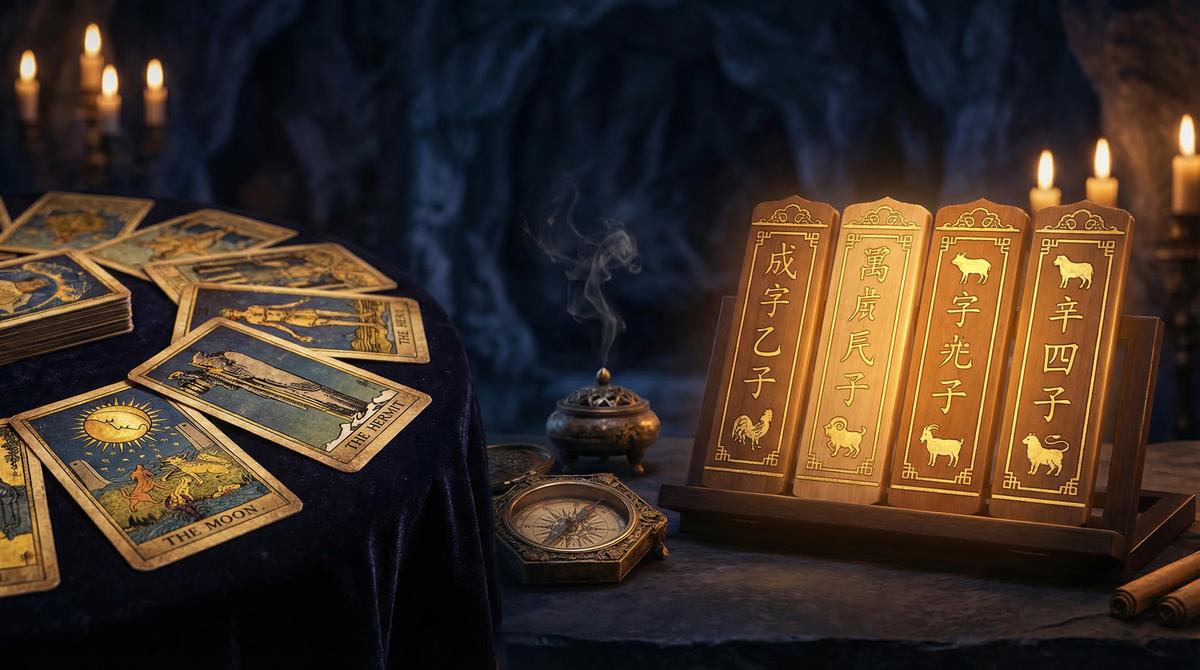
In the quest to understand the unknown, humanity has never ceased exploring. From the celestial trajectories of the East to the mysterious cards of the West, divination has served as a tool for insight and foresight across cultures and ages. Among all systems, Western Tarot and Eastern Bazi (Four Pillars of Destiny) stand as the two most representative traditions. Both attempt to answer our deepest questions, yet their philosophical foundations, methods, and applications differ profoundly.
"Tarot is a mirror reflecting the soul; Bazi is a map charting destiny. The mirror reveals the present; the map guides the journey ahead."
1. Philosophy: Intuitive Symbolism vs. Rigorous Mathematics
- Tarot: Rooted in psychology and symbolism, drawing on Carl Jung's concepts of synchronicity and the collective unconscious. Its 78 cards form a system of archetypal imagery. Tarot is an "art of intuition" -- it provides no absolute answers but offers a mirror to illuminate the querent's inner landscape.
- Bazi: Rooted in the ancient Chinese philosophy of "Heaven-Human Unity." It converts birth data into eight Heavenly Stems and Earthly Branches characters, creating a unique Five Elements energy field. Bazi is a "rigorous mathematical model" that posits destiny's general framework is set at the moment of birth.
2. Historical Origins: Renaissance Cards vs. Millennia of Chinese Wisdom
Tarot's history is relatively short, traceable to 15th-century Italy as a noble card game. It was not until the 18th-19th centuries that occult societies imbued it with divinatory significance, merging it with Kabbalah and Western astrology into the modern system we know today.
Bazi's roots run far deeper, stretching back to the ancient Yin-Yang Five Elements theory and the Stem-Branch calendar system. Refined through the Han, Tang, and Song dynasties, it was formalized by Li Xuchong (Tang) and Xu Ziping (Song). With thousands of years of practice and transmission, it is deeply woven into the fabric of Chinese civilization.
3. Use Cases: Specific Questions vs. Life Overview
- Tarot excels at specific, short-term questions: "Should I accept this job?" "How will my relationship evolve over the next three months?" It analyzes current energy states and short-term trends.
- Bazi excels at macro-level, long-term life planning: "What career suits me best?" "When will I meet my true partner?" "Which decade of my life will be most prosperous?" It provides a lifetime blueprint and navigation chart.
| Dimension | Tarot | Bazi |
|---|---|---|
| Core Principle | Synchronicity, collective unconscious, symbolism | Yin-Yang, Five Elements, Stems & Branches |
| Nature | Inspirational, psychological, non-deterministic | Systematic, destiny-mapping, quasi-deterministic |
| Time Scope | Short-term (typically 3-6 months) | Lifetime, 10-year Luck Pillars |
| Question Type | Specific events, relationship dynamics | Life patterns, career, marriage, health |
| Accuracy Depends On | Reader's intuition, querent's focus | Practitioner's skill, birth time accuracy |
4. Accuracy and Learning Curve
Tarot's accuracy is experiential -- the reading resonates with the querent's current state of mind and circumstances. Its precision relies heavily on the reader's empathy, intuition, and life experience. Entry-level learning is relatively accessible, but mastery requires exceptional sensitivity.
Bazi's accuracy is built on objective calculation rules. Given accurate birth data, different practitioners will arrive at similar foundational analyses. However, Bazi has a steep learning curve, requiring years of study to master complex theories of interactions, combinations, and transformations.
Conclusion: Choose the Right Wisdom Tool for You
Neither system is superior -- they serve different needs from different civilizations. Tarot is like a wise counselor, illuminating your present and offering multiple perspectives when you're lost. Bazi is like an experienced life strategist, charting your grand blueprint to help you ride favorable currents and avoid hidden reefs.
When standing at a crossroads over a specific decision, turn to Tarot. When seeking deep self-understanding and long-term planning, Bazi offers unparalleled depth of insight.
Explore the Roots of Eastern Wisdom
Bazi's theoretical foundation originates from the I Ching (Book of Changes). If you want to understand Eastern metaphysics from its source, begin your journey with our I Ching introductory course.
Start Learning I Ching