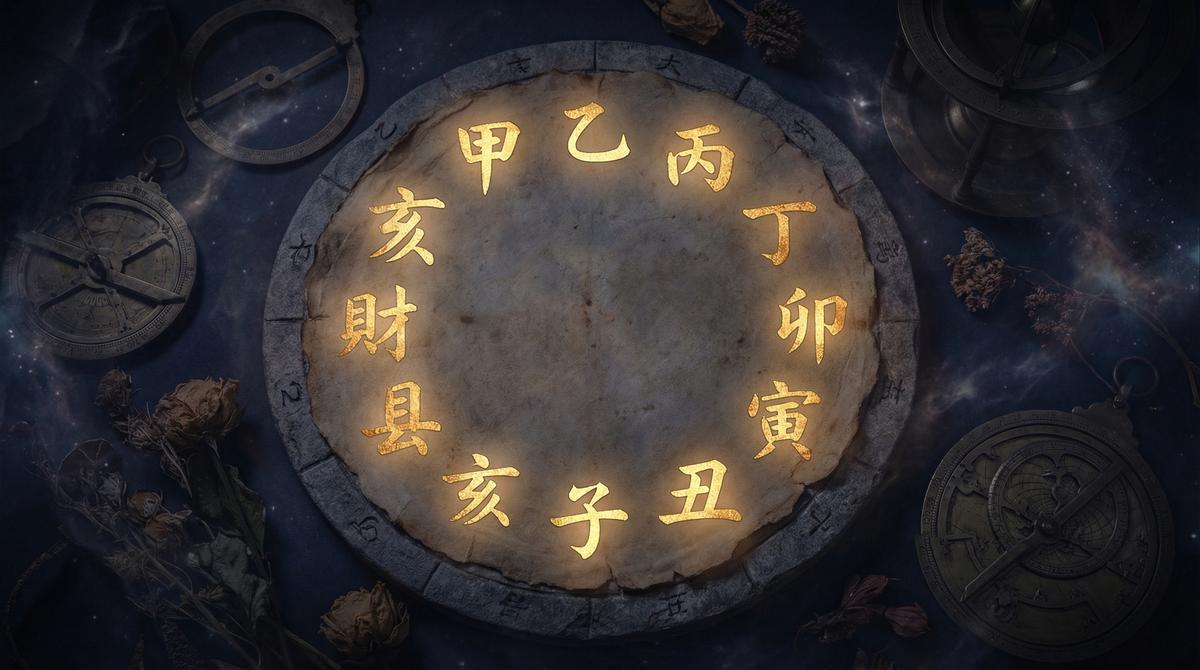
Whether you want to understand your birth chart, or are interested in traditional Chinese culture such as Feng Shui, Traditional Chinese Medicine, or calendars, the Heavenly Stems and Earthly Branches are a core concept that cannot be bypassed. It is not only a symbol used by the ancients to record time, but also a coding system containing profound philosophical ideas and cosmic laws. This article will take you from scratch to systematically understand this ancient and wise symbol system.
1. What are Heavenly Stems and Earthly Branches?
Heavenly Stems and Earthly Branches, abbreviated as "Stems and Branches," originated from ancient Chinese observations of celestial phenomena. The ancients believed that the movement and changes of all things in the universe are related to the operation of the Qi of heaven and earth. "Heavenly Stems" represent the Yang Qi law of celestial body movement, while "Earthly Branches" represent the Yin Qi law of seasonal changes on Earth. The combination of the two constitutes the Stems and Branches calendar, which is used to record years, months, days, and hours.
The Heavenly Stems and Earthly Branches are a unique symbolic system in ancient China. It is not only the cornerstone of the calendar, but also the core theoretical basis of many traditional numerology arts such as numerology, traditional Chinese medicine, and Feng Shui.
2. Ten Heavenly Stems: Energy Symbols of the Sky
There are ten Heavenly Stems: 甲, 乙, 丙, 丁, 戊, 己, 庚, 辛, 壬, 癸. They not only have an order, but are also endowed with Yin and Yang and the Five Elements attributes, symbolizing different states of cosmic energy.
| Heavenly Stem | Pinyin | Five Elements | Yin Yang | Symbol |
|---|---|---|---|---|
| 甲 | jiǎ | Wood | Yang | Towering Tree |
| 乙 | yǐ | Wood | Yin | Flowers and Vines |
| 丙 | bǐng | Fire | Yang | Fire of the Sun |
| 丁 | dīng | Fire | Yin | Candlelight Fire |
| 戊 | wù | Earth | Yang | High Mountain Wall |
| 己 | jǐ | Earth | Yin | Garden Wet Soil |
| 庚 | gēng | Metal | Yang | Swords and Axes |
| 辛 | xīn | Metal | Yin | Jewelry |
| 壬 | rén | Water | Yang | Rivers and Lakes |
| 癸 | guǐ | Water | Yin | Rain and Stream |
3. Twelve Earthly Branches: The Rhythm Cycle of the Earth
There are twelve Earthly Branches, which correspond to the twelve zodiac animals and also have the attributes of the Five Elements and Yin and Yang. The Earthly Branches more profoundly reflect the seasonal changes and time changes on Earth.
| Earthly Branch | Pinyin | Zodiac | Five Elements | Yin Yang | Corresponding Month (Lunar) |
|---|---|---|---|---|---|
| 子 | zǐ | Rat | Water | Yang | November |
| 丑 | chǒu | Ox | Earth | Yin | December |
| 寅 | yín | Tiger | Wood | Yang | January |
| 卯 | mǎo | Rabbit | Wood | Yin | February |
| 辰 | chén | Dragon | Earth | Yang | March |
| 巳 | sì | Snake | Fire | Yin | April |
| 午 | wǔ | Horse | Fire | Yang | May |
| 未 | wèi | Goat | Earth | Yin | June |
| 申 | shēn | Monkey | Metal | Yang | July |
| 酉 | yǒu | Rooster | Metal | Yin | August |
| 戌 | xū | Dog | Earth | Yang | September |
| 亥 | hài | Pig | Water | Yin | October |
4. The Soul of the Stems and Branches: The Five Elements' Generation and Restriction
The reason why the Stems and Branches can be used to deduce all things is that the core lies in the Five Elements (Wood, Fire, Earth, Metal, Water) relationships behind them. There are two basic relationships between the Five Elements: mutual generation and mutual restriction.
- Five Elements' Mutual Generation: Represents a relationship of promotion, reproduction, and benefit.
- Wood generates Fire (burning wood produces fire)
- Fire generates Earth (objects turn into ash and soil after burning)
- Earth generates Metal (metal minerals are in the soil)
- Metal generates Water (metal surfaces can condense water vapor under temperature differences)
- Water generates Wood (water nourishes the growth of trees)
- Five Elements' Mutual Restriction: Represents a relationship of restriction, control, and inhibition.
- Wood restricts Earth (the roots of trees can penetrate the soil)
- Earth restricts Water (earth can build dikes to block water)
- Water restricts Fire (water can extinguish fire)
- Fire restricts Metal (fire can melt metal)
- Metal restricts Wood (metal tools can cut down trees)
These generating and restricting relationships are the basis for analyzing the Eight Characters and Feng Shui's auspiciousness. For example, if a person's Eight Characters have too much "Wood" element, it needs "Metal" to restrict it, or "Fire" to consume it, in order to achieve balance in the Five Elements.
5. Combination of Stems and Branches and the Sixty Jiazi
The Heavenly Stems and Earthly Branches are combined in an orderly manner according to the rule of "Yang Stem matching Yang Branch, Yin Stem matching Yin Branch", starting from "Jiazi" and ending with "Guihai", forming a total of 60 unique combinations, which is the famous "Sixty Jiazi" or "Sixty Flower Jiazi". This cycle is widely used to record years. For example, the "Jiawu War" (1894) that we often mention is named after the Stems and Branches year of that year.
The Sixty Jiazi cycle repeatedly, forming an important time cycle in the traditional Chinese calendar, and also provides a rich combination of changes for Eight Characters numerology.
6. Application in Eight Characters Numerology
Eight Characters numerology, also known as "Four Pillars Prediction", is based on the theory of Heavenly Stems and Earthly Branches. A person's birth time (year, month, day, hour) can be represented by a set of Stems and Branches, a total of four sets, namely "Four Pillars".
- Year Pillar: Consists of the Stems and Branches of the year of birth, representing ancestors, foundation and early fortune.
- Month Pillar: Consists of the Stems and Branches of the month of birth, representing parents, siblings and youth fortune.
- Day Pillar: Consists of the Stems and Branches of the date of birth, where the Day Stem (Day Master) represents the person, and the Day Branch represents the marriage palace.
- Hour Pillar: Consists of the Stems and Branches of the hour of birth, representing children, career and old age fortune.
By analyzing the Five Elements represented by these eight characters (four stems and four branches) and their mutual generating, restricting, transforming, conflicting, harmonizing, and harming relationships, numerologists can infer a person's personality traits, destiny trends, relationships with relatives, and lifelong good and bad fortune. For example, a person whose Day Master is "Jia Wood" is usually upright, kind, and motivated, eager to grow like a towering tree.
Conclusion
The Heavenly Stems and Earthly Branches are not just cold symbols, they are the crystallization of the wisdom of the ancient Chinese in observing, understanding, and trying to live in harmony with the universe. Mastering the basic knowledge of the Stems and Branches is like getting a key that can open the door to many profound fields in traditional Chinese culture. I hope this article can lay a solid foundation for you and lead you into this fascinating world of metaphysics.